|
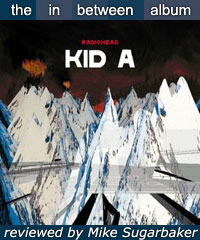
Radiohead,
"Kid A"
- reviewed by Mike Sugarbaker
Some rock bands, when they're at their best, are always going to
be about adolescence - think of Pearl Jam, The Who, the Sex Pistols,
a thousand now-anonymous balladeers from the fifties, and Radiohead.
We can laugh about Radiohead's first single "Creep" now, but if
you were in high school when it came out, you probably still love
it in some way. Radiohead's two albums since that time, The
Bends and OK
Computer, refined the quintessentially teenage melancholy
and bile, and sometimes even turned away from it for a few minutes.
One could read OK Computer's social commentary as a teenager
going through an activism phase.
The low point of Radiohead's rock-as-adolescence history came with
their stylised 1999 tour documentary Meeting
People Is Easy, which tried to unveil supposedly-glamourous
rock star lives as mostly composed of tedium and frustration, but
only ended up glamourizing boredom, which any indolent teenager
can appreciate. If it weren't for a few images and scenes (like
the early washed-out shot of lead singer Thom Yorke regarding a
stadium full of "Creep" sing-along-ers who are all apparently unaware
of the irony, and the unbroken shot of Yorke adding a track of electronic
bleeps and squawks to the great B-side "Palo Alto" with kid-like
enthusiasm), Meeting People's total impact would be the not-quite-earth-shattering
fact that rock journalists ask lots of stupid questions. It would
amount to an eye roll. Geez, Dad, you're so dumb.
I'm not saying that Radiohead needs to grow up - if they did that,
they'd virtually cease to be. But, as many of my friends are discovering
(phobic of the word "adult" as they are), interesting things start
to happen when you let go of both adolescence and responsibility,
and live in between for awhile. That's where Radiohead is on their
new album Kid A.
Much has already been made in advance reviews of the absence of
hard-rockin' tracks, the preponderance of "ambient" approaches.
The first two tracks, "Everything In Its Right Place" and the title
track, use the same clean-room bell-like synthesizer sounds as countless
"intelligent dance music artists" have in the past couple of years.
Yorke's famously anguished tenor seems less adamant, and frankly
less necessary (although not unnecessary). Most of the time I couldn't
tell you what the hell he's talking about when he does sing, but
that's not a big switch. (Kid A includes no lyrics in its
artful, clever packaging. When it does include words, it makes you
work to find them.) It's been described as a sort of practice-drill
album, with a "real" album, one with proper rock songs, to follow
early next year. (Rock does show up, on the vaguely U2-ish strum-and-strings
waltz "How To Disappear Completely," and on "Optimistic," which
just sounds like Radiohead only more reserved, with a curious disco
coda. And, actually, on about half of the album's 10 tracks.)
Often, when people start to leave adolescence, you actually find
out specific things about them for the first time. All that bombast
gets out of the way and reveals real personality traits. On Kid
A, Radiohead focuses for the first time on its love of sound
for sound's sake. The album's theme (the name Kid A supposedly refers
to the first successfully cloned human, and the sense of rootlessness
he or she would feel in a world increasingly full of artificial
life) manifests on every track as a spare, drier-than-a-martini
sound. Even the long, rich synth washes we've become used to on
a decade of ambient techno records (most prominent here on "Treefingers")
seem deliberately sapped of life. Lyrically, the thematic focus
helps Yorke seem a little less pissy and more subtle. The dark,
scared point of view is still there, though: "In a little while/I'll
leave home/The moment's already passed/Let's go/and I'm not here/This
isn't happening," he sings on "How To Disappear Completely." Everything
speaks to a liminal state, nothing quite becomes real and touchable.
The actual horns that percolate through "The National Anthem" sound
synthetic, and throughout the album the strings can never be called
warm. Some of the song titles seem like they might have been placeholders,
meant to suggest a texture ahead of time, like the texture is all
that mattered. (The accordion-slow, beautifully light and fake,
sweetly sad closer is titled "Motion Picture Soundtrack.")
I don't mean to be dismissive when I say that Kid A feels
a bit like a collection of unreleased B-sides. Frankly, if you don't
own the B-side collection/maxi-single Airbag/How Am I Driving,
you're missing some of the band's best recent work, in the form
of some great instrumental tracks that prefigure the techno-influenced
work on the new album. None of the tracks on Kid A has that
heft of authority that everything on OK Computer has - it
all feels like it was intended to be ephemeral, if not obscure.
And Kid A's story, if there really is one, feels like a human B-side,
a life not created to have any intrinsic worth, with no center.
Or like the gap between growing up, and kicking out more pissy,
low-self-esteem, completely important Radiohead songs.
b i o :
Mike Sugarbaker
is the creator of gibberish.com
and indexcards.com. He
lives and works within the blast radius of Silicon Valley.
|